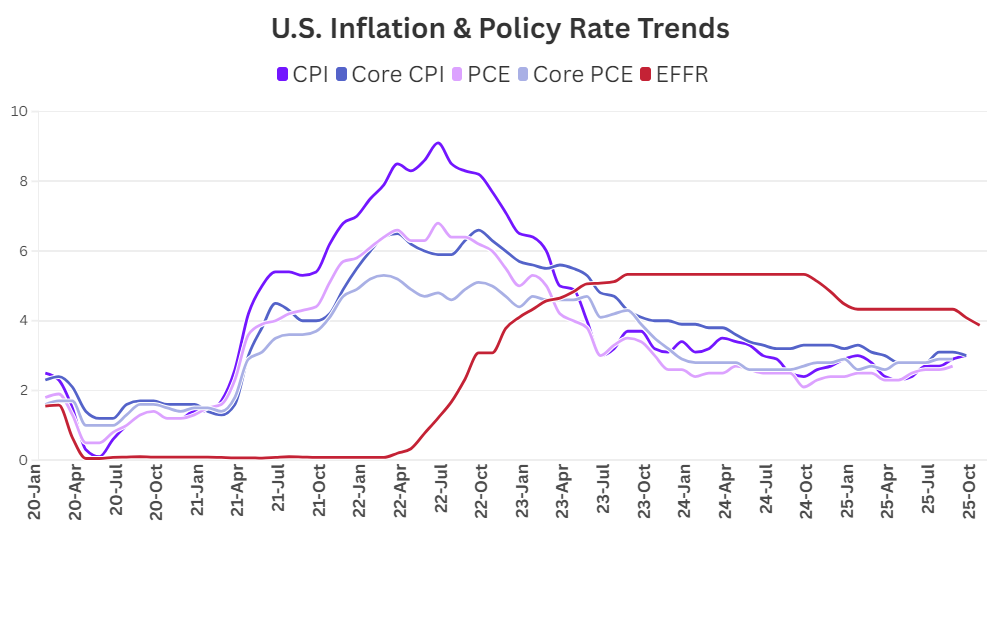
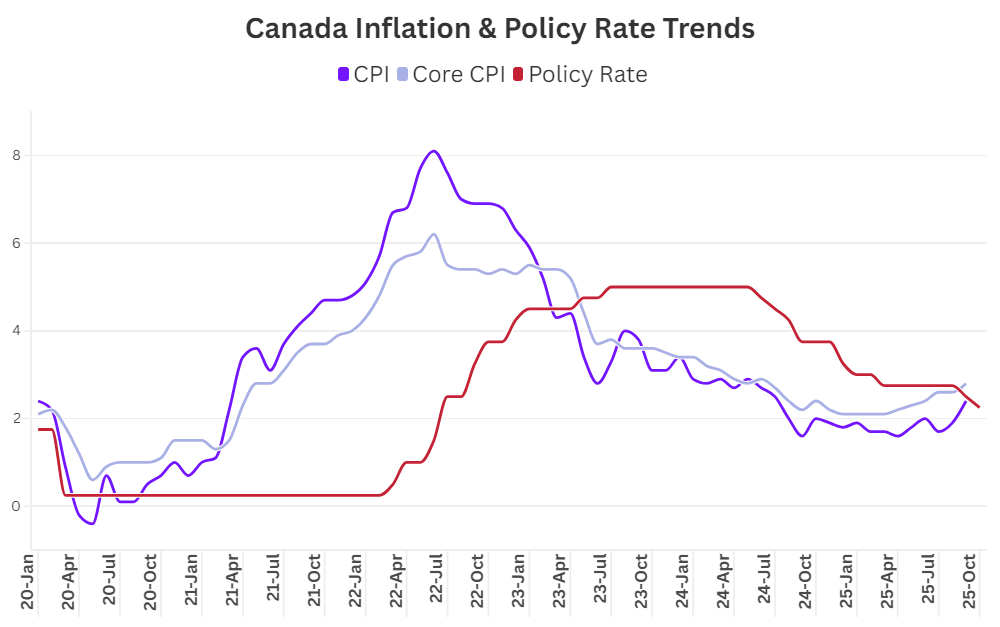
The Federal Reserve and the Bank of Canada both cut rates by 25 bps today, moves that were widely anticipated by markets. This marks the Fed's second consecutive cut, bringing the policy rate range down to 3.75%-4.00%. Meanwhile, this is the BoC's fourth cut in 2025, bringing its policy rate down to 2.25%.
Both decisions come at a time when inflation and labor market trends are diverging on both sides of the border. Uncertain economic data clouds the Fed’s path forward, as the BoC grapples with rising unemployment and sluggish economic conditions.
United States
Last Meeting: October 29, 2025
Decision: Cut 25bps to 3.75%-4.00% range, second cut since December 2024
Remaining meetings in 2025: December 9-10, 2025
Comments:
The Fed has shifted focus from inflation concerns to labor market risks, with Chair Powell characterizing recent moves as "risk management cuts". Despite both headline and core CPI coming in at 3% in September, monetary policymakers still see room to ease further given job market weakness.
The Fed's September projections pointed to another 50bps of cuts by year-end, suggesting another 25bp cut in December, and one more in 2026. Only one additional cut expected for 2026 signals that the Fed sees persistent inflation or job weakness as plausible, and is leaving policy flexible as new data emerges. Chair Powell “In the near term, risks to inflation are tilted to the upside, and risks to employment to the downside - a challenging situation.”
Canada
Last meeting: October 29, 2025
Decision: Cut 25bps to 2.25%, bringing cumulative cuts to 275bps since June 2024
Remaining meetings in 2025: December 10, 2025
Today’s cut puts rates at 2.25%, the lower end of the BoC's neutral range (2.25%-3.25%), and just below September’s CPI of 2.4%. While recent elevated inflation numbers have introduced uncertainty, the weak labor market and tariff-induced economic headwinds drove the case for this cut.
BoC governor Tiff Macklem stated there will be no more cuts if inflation remains around the 2% mark, assuming economic growth evolves in line with expectations. He also stressed that tariff-related economic damage cannot be solved by cutting rates. Barring any major changes in the next two months, rates should hold steady until early 2026.
September Inflation - United States
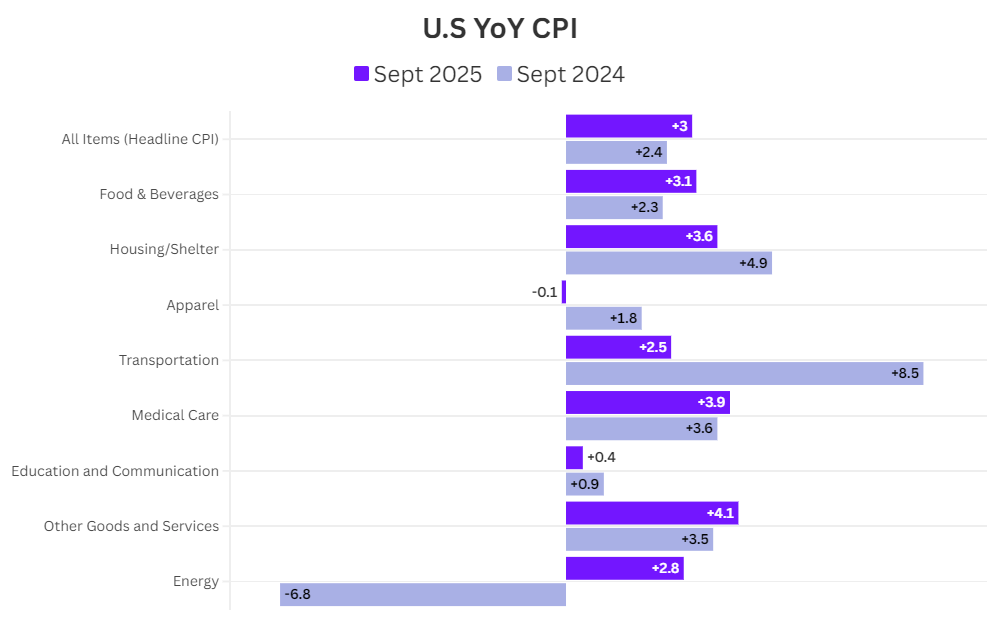
CPI: 3% (up from 2.9% in August)
Core CPI: 3.0% (down from 3.1% in August) Major Category Changes:
- Shelter: 3.6% (unchanged)
- Food & Beverage: 3.1% (down from 3.2% in August)
- Transportation: 2.5% (down from 3.5% in August)
Comments:
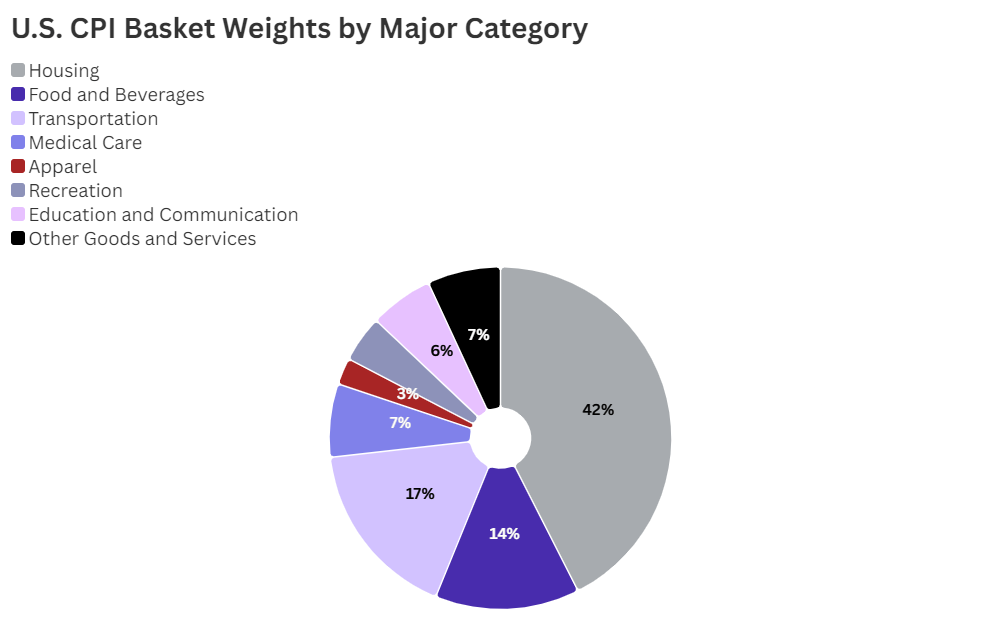
The September report showed inflation as "cooling but sticky," with headline CPI coming in higher at 3%, but slightly below expectations. Gasoline (~3% of CPI) was the largest contributor behind the CPI uptick this month, going up 4.1% on a monthly basis. Electricity (+5.1% vs +3.7%) and natural gas (+11.7% vs +2%) are also up compared to this time last year.
For the past 6 months, food inflation has not dropped below 2.8%, and is trending higher than 2024. Shelter has consistently gone down since last year, coming in at its lowest of the year in September. Energy has experienced the largest swing since last year (2.8% vs -6.8%), making it a key category to watch heading into 2026.
September Inflation - Canada
Headline CPI YoY: 2.4% (up from 1.9% in August)
Core CPI:
- CPI-Trim: 3.1% (up from 3% in August)
- CPI-Median: 3.2% (unchanged from August)
- CPI ex food & energy: 2.4% (unchanged from August)
Major Category Changes:
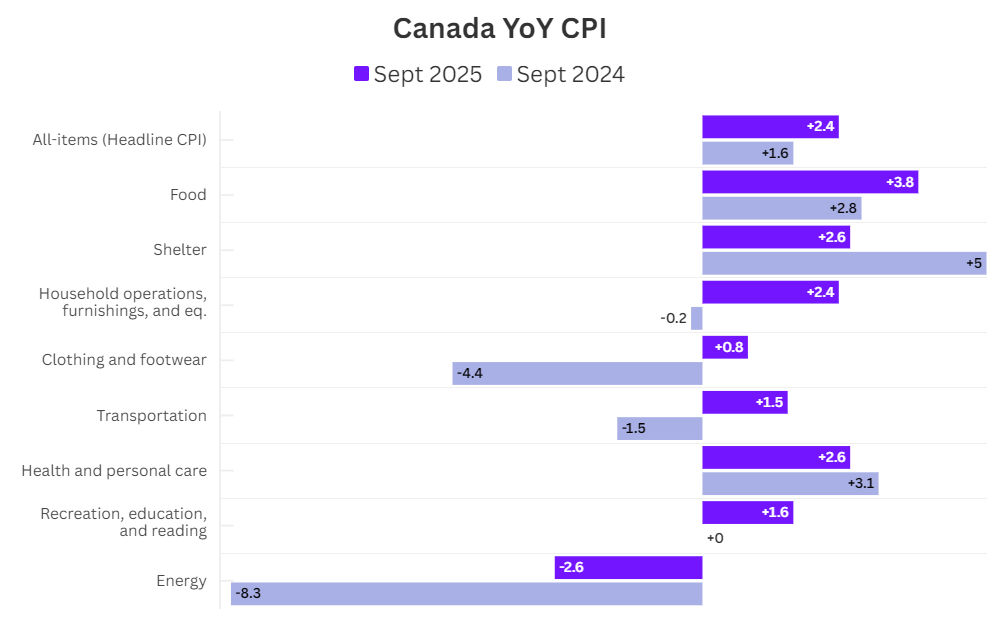
- Food: 3.8% **** (up from 3.4% in August)
- Shelter: 2.6% (unchanged from August)
- Transportation: 1.5% (up from -0.5% in August)
Comments:
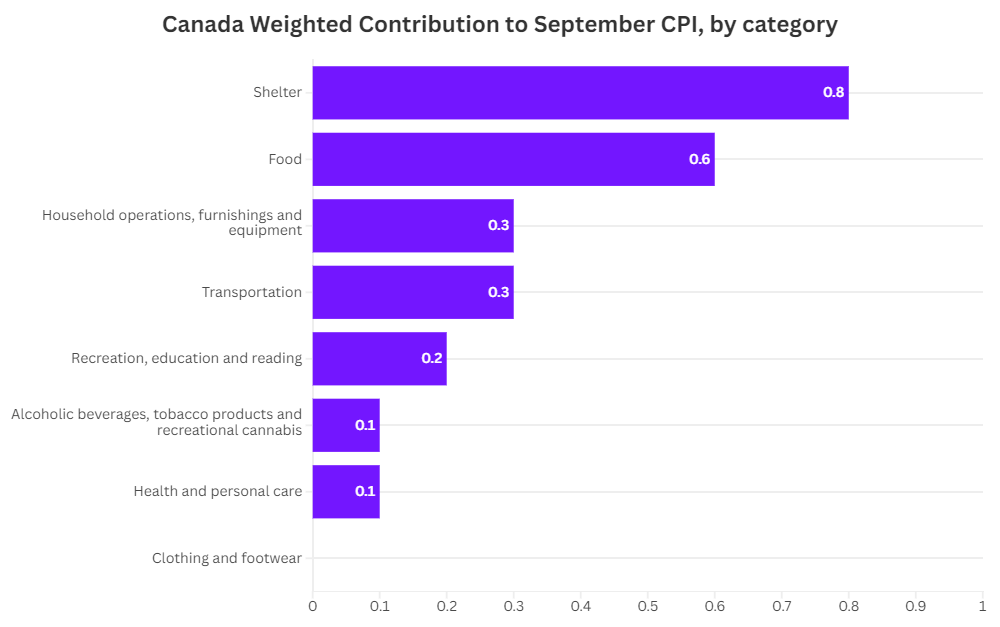
September CPI surprised to the upside, coming in at 2.4% with expectations at 2.2%. Energy’s disinflationary effect on CPI was much lower this month, driving the uptick in headline CPI. For context, energy CPI came in at -8.3% last year, compared to -2.6% this year. Most other categories remained relatively stable. Food and shelter continue to be the stickiest components, with no meaningful downward momentum expected in the near term.
Given rates are now below September CPI, upcoming inflation numbers will play a pivotal role in the BoC’s decisions.
With the Federal Reserve and Bank of Canada both cutting rates, the real question is how persistent job weakness and inflation will be? Without major policy changes, 2026 could see central banks caught in a stagflationary environment, challenged by sticky inflation and ongoing labor market softness.